

Survey Says…Pay Raises Are Flat but Promotional Raises are Up for 2016
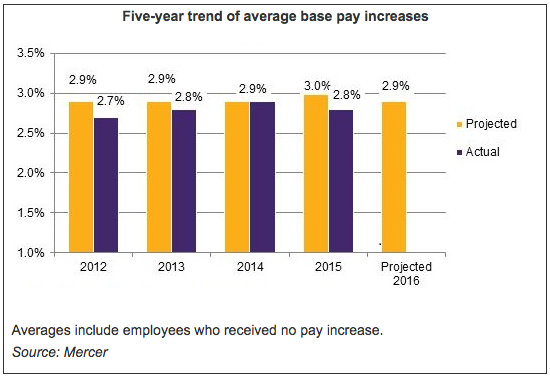
According to Mercer’s 2015/2016 U.S. Compensation Planning Survey, the average salary increase budget is expected to be 2.9 percent in 2016, up slightly from the average increase budget of 2.8 percent in 2015.
The survey includes responses from 1,504 midsize and large employers across the U.S. and reflects pay practices for more than 17 million employees.
Affordable Care Act Forms MUST be Provided to Employees by January 31, 2016
Small employers (those with fewer than 50 FTEs) with a self-insured health plan must complete and file Forms 1095-B (Health Coverage) and 1094-B (accompanying transmittal form) with the IRS, as well as provide employees—specifically, those who are taxpayers...
2016 IRS Form W-4
Click here to download the 2016 IRS Form W-4.
Employer Discrimination Test
Employers need a discrimination prevention checklist. Here it is!
The more questions to which you answer “Yes,” the more you are doing to prevent discrimination based on race, age, religion, national origin, gender, or other protected classes in your workplace in terms of hiring, promotion, and dismissal.
To avoid discrimination in supervisory tasks, do you:

NLRB Guidance on Employer Handbooks
p>The National Labor Relations Board (NLRB) has recently given guidance to employers regarding Section 7 rights of the National Labor Relations Act (NLRA). The NLRB offered employer guidance on language employers should not consider including in their employer handbooks.
What is NLRA Section 7 Rights?
Policies Employers Should Consider for Review!
The NLRA Section 7 applies to both union and nonunion employers, guarantees employees the right not only to bargain collectively, organize, form, join, or assist labor organizations, but also the right to engage in “other concerted activities” for the purpose of collective bargaining or other mutual aid and protection. Section 8 of the Act then makes it an unfair labor practice for an employer to “interfere with, restrain, or coerce” employees in their exercise of these rights. Section 7 grants employees the right to communicate about wages, hours, and any other terms and conditions of employment. This communication may occur among coworkers at the company locations or with other third parties on social media.
When reviewing employer policies and practices for compliance with the Act, the NLRB determines whether a rule would have a “chilling effect” on employees’ Section 7 activity. The Board determines whether employees would reasonably construe the policy to prohibit or restrict their activity. Consequently, the NLRB’s broad interpretation of Section 7 rights has placed all sorts of employer policies under scrutiny.


